Menu
DOccMed portfolio guidance and review
How to Write a Strong DOccMed Portfolio
Review your Workplace Assessment and Clinical Case against the areas that matter most. Identify what is missing, unclear, or too generic before you submit your DOccMed portfolio.
The Portfolio Review gives structured, exam focused feedback on occupational reasoning, risk assessment, work relatedness, functional impact, adjustments, consent, communication, and follow up.
Try the review free. A full portfolio review is £59, an introductory price (normally £89).
I tested it on a portfolio I had already passed, and the feedback was almost the same as the original assessment. To me, that makes it a very credible tool for those preparing for the exam.
Improve the document before you submit it
A portfolio review is for the point before submission, when you need clarity on what to strengthen. It is not a replacement for the formal assessment process. It is a practical way to find the highest impact improvements while you can still act on them.
Best for
- Before portfolio submission
- Identifying high impact improvements
- Strengthening occupational reasoning
- Creating a focused final revision plan
What a strong DOccMed portfolio needs to demonstrate
A strong DOccMed portfolio is not simply a well written account of a workplace visit or clinical consultation. It shows practical occupational medicine reasoning.
Workplace Assessment
Show that you can observe a real workplace, identify meaningful hazards, assess risk systematically, interpret available information, recommend proportionate controls, and communicate clear priorities.
Clinical Case
Show that you can connect the health condition to work, assess functional impact, give practical occupational health advice, manage consent and communication appropriately, and plan proportionate follow up.
The strongest submissions are specific. They explain why a risk, recommendation, adjustment, or conclusion is appropriate for that worker or workplace, rather than relying on generic occupational health language.
What you receive
Clear overall guidance
A broad assessment of the portfolio's current strength, with the important caveat that this is guidance rather than an official mark.
Prioritised improvement points
Feedback is ordered by likely impact, so you can focus on what matters most before submission rather than being left with a long, unranked list of comments.
Occupational reasoning feedback
Identify where the work demands, functional impact, risk, adjustments, consent, or professional reasoning need clearer explanation.
Why not just use ChatGPT?
It is a fair question. Many candidates paste their draft into a general chatbot. Here is where a purpose built review differs.
Built for anonymised portfolios
Pasting a real Workplace Assessment or Clinical Case into a general chatbot means putting patient, worker, and employer detail into a consumer tool. This review is built around anonymised documents: it checks for identifiers before it starts, uses the file only for the review, and does not keep the original. You still anonymise before uploading, but the whole flow is designed around that.
It knows what a DOccMed portfolio is
A general chatbot gives general writing feedback. This reviews your work against the structure the Faculty expects, the Workplace Assessment and Clinical Case, subsection by subsection, looking for the occupational reasoning, risk justification, and functional analysis that carry marks. You do not have to know the mark scheme well enough to prompt it, because that is built in.
The same portfolio gets the same review
Ask a chatbot to mark the same draft twice and you can get two different answers and two different verdicts. Your review is worked out once, saved, and stays the same each time you open it, so you act on considered feedback rather than a different reply each time you paste.
Ordered by what costs marks
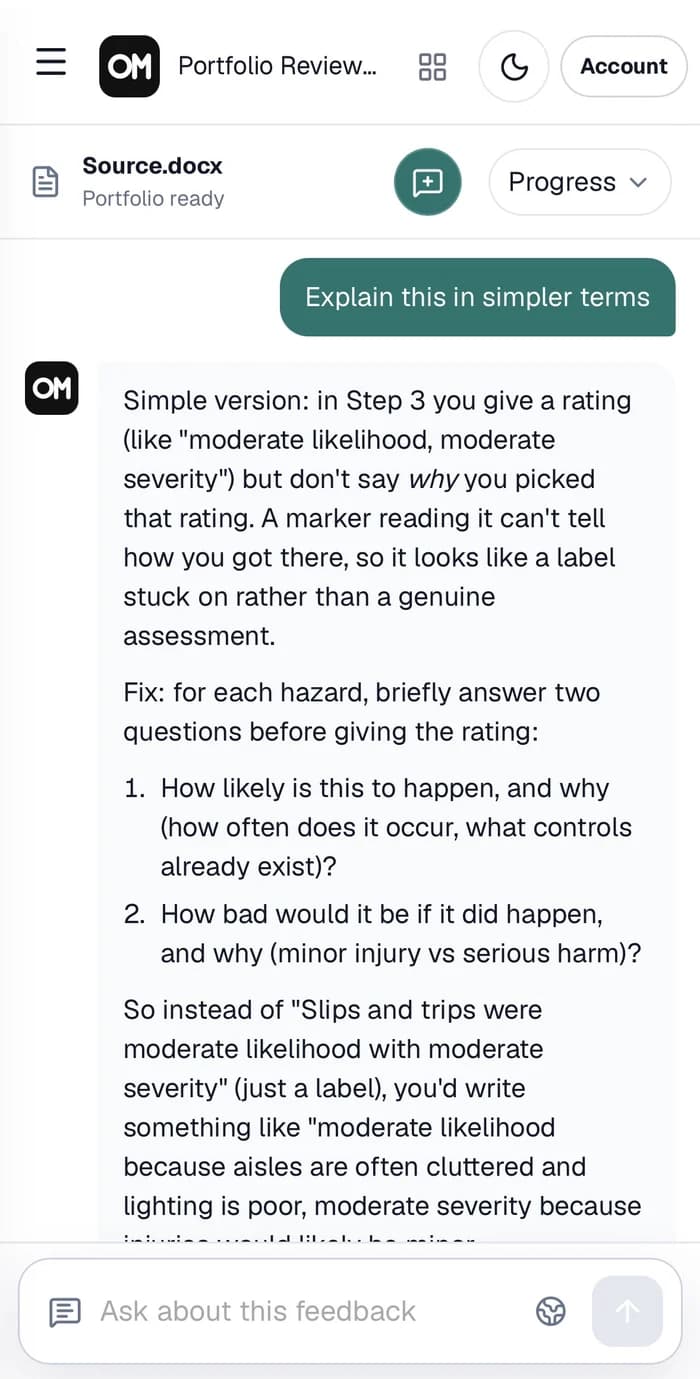
Feedback is prioritised by likely impact and quotes your own wording back to you, so your remaining time goes into the changes that matter rather than a long unranked list. Once you have revised, a second pass compares your new version against the original and the advice you were given.
The clearest way to judge it is on your own portfolio. The first subsection of each part is free, with no card required.
Feedback that tells you what matters most
The value is not simply receiving more comments. It is understanding which changes are most likely to improve the quality and submission readiness of your portfolio.
Your review is organised into practical priorities:
- Must address before submission
- Would materially strengthen the portfolio
- Useful refinements
This helps you use your available time well instead of trying to perfect every line equally.
DOccMed portfolio questions candidates ask before submission
What should a strong DOccMed Workplace Assessment include?
A strong Workplace Assessment does more than describe a site. It should show a clear understanding of the work process, the hazards actually observed, who may be exposed, the likely health effects, existing controls, and the reasoning behind your risk priorities. It should also explain what further investigation, measurement, health surveillance, or control action may be relevant.
What should a strong DOccMed Clinical Case include?
A strong Clinical Case shows how the health condition affects work, how work may affect the condition, and how occupational health advice supports safe and sustainable work. It should connect the clinical facts to occupational history, work relatedness, functional limitations, adjustments, consent, communication, and follow up.
What is the difference between a clinical case report and a DOccMed Clinical Case?
A DOccMed Clinical Case should not read like a general medical case report. Clinical detail matters, but it needs to support occupational analysis. The portfolio should make clear what the worker can and cannot do, what workplace factors may be relevant, what adjustments are proportionate, and how the advice will be communicated and reviewed.
How detailed should a DOccMed risk assessment be?
The strongest risk assessments explain why a risk matters in that workplace. They link the hazard to the source, exposed workers, potential harm, exposure pattern, existing controls, and the reason for the priority given. Simply listing hazards or calling them high, medium, or low risk without explaining the reasoning is usually not enough.
How do I show occupational reasoning in my portfolio?
Occupational reasoning means showing how you moved from the facts to practical advice. Explain the relationship between work and symptoms, the functional effect of the condition, the safety implications, the adjustment options considered, why your recommendation was proportionate, and how you would review the outcome.
What are common weaknesses in a DOccMed portfolio?
Common weaknesses include generic workplace descriptions, hazards not linked to health effects or controls, unjustified risk ratings, too much clinical detail with too little occupational analysis, vague recommendations, unclear functional restrictions, and insufficient explanation of consent, communication, or follow up.
How can I tell whether my portfolio is ready to submit?
Before submitting, check that both required sections are present, the current official template has been used, confidential information has been removed, references are included, assessed writing is in the main body, and your strongest detail is concentrated in the areas that require the most reasoning. A structured review can help identify the highest impact changes before your deadline.
What the review can and cannot do
The review is designed to give useful, exam focused guidance. It does not provide an official Faculty assessment, an exact score, or a guaranteed outcome.
It will not invent information that is missing from your portfolio. Where a section is unclear or incomplete, the feedback will identify what may need to be clarified or strengthened.
You should manually check word counts yourself. AI can comment on the apparent balance and detail of a section, but it is not reliable enough for precise word counting.
Prepare safely before you upload
Please anonymise your portfolio before uploading it. Remove patient, employer, and personal identifiers, including names, addresses, dates of birth, NHS numbers, contact details, and any information that could reasonably identify a person or workplace.
You remain responsible for ensuring the material you submit is fully anonymised.
Portfolio Review questions
Will I receive an exact mark or guaranteed outcome?
No. The review provides guidance rather than an official Faculty assessment. It does not give an exact score or guarantee a pass. Where appropriate, it uses broad guidance bands to help you understand the likely strength of the portfolio.
Can the review check my word count?
It can comment on whether a section appears too brief or overly detailed, but you should manually check word counts yourself. AI is not reliable enough for precise word counting, particularly in structured documents containing template text, tables, and headings.
Do I need to anonymise my portfolio before uploading it?
Yes. Remove patient, employer, and personal identifiers before uploading. Do not include names, addresses, dates of birth, NHS numbers, contact details, or other information that could identify a person or workplace.
Get clarity before you submit
Try the Portfolio Review free, then get your full structured review for £59 (£89 after the introductory period) when you are ready.